
If you feel like the conversation around Artificial Intelligence has shifted recently, you aren’t wrong. We have officially entered the wave of Agentic AI.
Two of the world’s largest companies recently published jaw-dropping automation numbers, and global investment in AI operations has just hit a massive new milestone. The days of treating AI as a simple chatbot or a novelty tool are over. Today, the companies in your industry your direct competitors are actively rebuilding how their operations run from the ground up.
Here is a look at the data driving this shift, why the majority of AI implementations still fail, and how your business can capture the true ROI of intelligent automation.
The Great AI Restructuring
To understand the scale of this shift, look no further than recent data from top global research firms.
According to Gartner, by the end of 2026, 40% of enterprise applications will integrate task-specific AI agents. To put that in perspective, that number was less than 5% just last year. Furthermore, Deloitte reports that a staggering 99% of IT leaders are currently restructuring their operations around AI agents.
But what does that actually mean in plain language?
It means AI agents are no longer just answering questions. They are actively executing multi-step workflows, handling approvals, managing customer interactions, and running complex processes from end to end. The companies making this shift aren't just seeing marginal improvements; they are reporting 20% to 40% productivity gains. That isn't just a tech upgrade—that is a structural market advantage.

The Real-World ROI: From Billions Saved to Seconds Spent
When implemented correctly, the financial impact of Agentic AI is staggering.
- JPMorgan Chase utilized AI to reduce 360,000 manual work hours down to mere seconds.
- IBM implemented AI across its enterprise and realized $3.5 billion in cost savings alongside a 50% increase in productivity.
These are not isolated success stories. According to McKinsey, companies that adopt AI at scale can increase cash flow by up to 20% while cutting operational costs by 30%. Intelligent automation is currently delivering 50% to 70% cost reductions in targeted workflows, with aggressive payback timelines of just 6 to 12 months for well-executed implementations.
The Warning: Why 60%+ of AI Implementations Fail
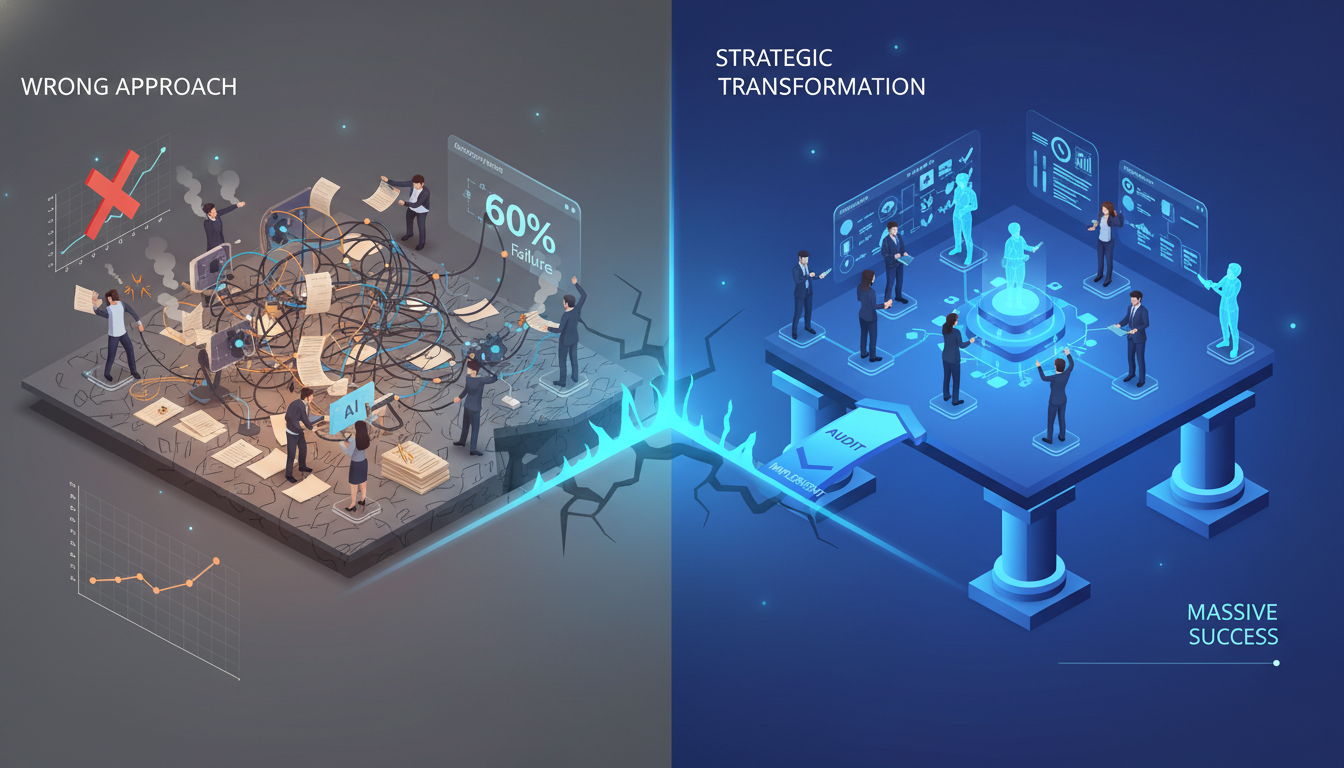
With numbers that good, why isn't every business experiencing these results? Because more than 60% of AI implementations still fail.
This failure rarely happens because the technology itself is flawed. It happens because businesses treat AI like a simple plug-and-play tool rather than a catalyst for strategic transformation. You cannot layer advanced automation over broken, undocumented, or inefficient processes and expect a miracle.
Auditing your current operations before you implement technology is the single biggest factor that separates a massive success from an expensive failure.
The Hidden Cost of Inaction
You might be thinking, "We'll just wait until the technology matures." But waiting is currently costing you money.
Data shows that organizations that haven't automated their core workflows are losing 20% to 30% of their annual revenue to re-keying data, duplicate efforts, and lost approvals. That is money leaving your business every single year.
The global workflow automation market is on pace to hit $19.6 billion by 2026 (up from $13 billion four years ago). PwC estimates that AI will contribute $15.7 trillion to the global economy by 2030.
The question is no longer if AI can deliver ROI. The question is: Which of your workflows are leaving money on the table right now?
The Microswift Approach: Implementation is the Gap
Today, AI capability is no longer the gap, implementation is. The companies that will win in 2026 are taking the time right now to understand their own workflows.
That is exactly where Microswift comes in. We don't just sell you software; we restructure your operations for success. We do this through a proven three-step process:
- Audit: We start with a comprehensive operations audit—a structured, interview-based review of how your business actually runs.
- Identify: We pinpoint the exact workflows leaving money on the table and identify your highest-ROI AI opportunities.
- Implement: We build and deploy these solutions with you, step-by-step, ensuring a seamless end-to-end transformation.
If you are ready to stop experimenting with AI and start experiencing real operational ROI, it starts with an audit.
[Ready to transform your workflows? Visit www.Microswift.ca to schedule your Operations Audit today.]


